

356 and A356 aluminum casting alloys differ in compositional tolerances and chemical control, directly influencing strength, ductility, and reliability. At Precision Enterprises, we pour both 356 and A356 regularly. Both are proven, high-performance aluminum-silicon-magnesium alloys that cast well and machine beautifully, especially when paired with our in-house CNC machining and engineering review.
356 vs. A356 Aluminum
The difference comes down to chemistry control and performance requirements. Read on to learn more.
356 Aluminum
Reliable. Cost-effective. Proven.
356 is one of the most widely used aluminum sand casting alloys in the industry. It offers:
- Excellent castability (fills molds cleanly and consistently)
- Good strength-to-weight ratio
- Strong corrosion resistance
- Very good machinability
- Excellent response to heat treatment (T6)
For many industrial applications…including pumps, housings, brackets, agricultural components, marine parts, and general structural castings…356 performs extremely well while maintaining cost efficiency.
If your application requires:
- Solid mechanical properties
- Reliable performance
- Competitive pricing
- Tight tolerances with machining
356 is often the right choice.

A356 Aluminum
Cleaner chemistry. Higher performance. Greater ductility.
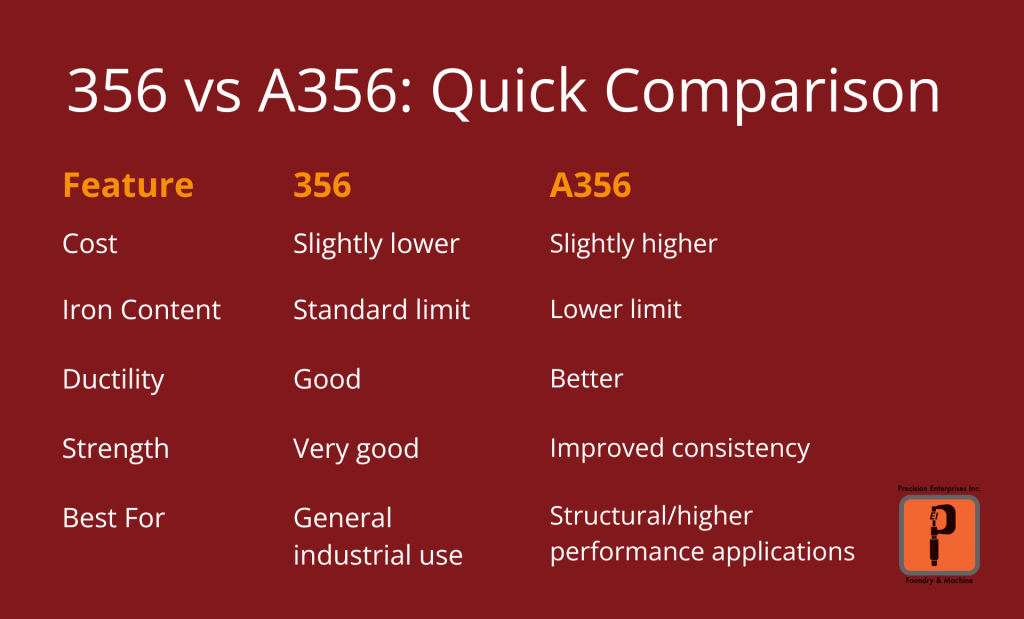
A356 is essentially a tighter-controlled version of 356. The key difference is lower allowable iron content and stricter chemistry limits.
Why that matters to you:
Lower iron means:
- Improved ductility (less brittle behavior)
- Better elongation
- Higher structural integrity
- Reduced risk of cracking under load
This makes A356 especially valuable for:
- Automotive structural components
- Electric & hybrid vehicle applications
- Robotics
- Medical device components
- Load-bearing or safety-critical parts
If your part must handle higher stress, impact resistance, or stricter mechanical requirements, A356 is often the better fit.
From Our 80-Year-Old Aluminum Foundry’s Engineering Perspective
The alloy choice isn’t just about material. It’s about the full manufacturing process.
Because we:
- Pour in multiple foundries with multiple furnaces
- Run Sinto automatic molding lines and air set processes
- Machine over 95% of what we cast
- Operate 25+ CNC machining centers
- Offer coating, anodizing, powder coating, and secondary services
- Maintain ISO 9001:2015 certification
We supply finished, engineered solutions, not just supply raw castings (unless that’s what you need).
When we review your project, we look at:
- Load requirements
- Machining tolerances
- Wall thickness
- Heat treatment needs
- Cost targets
- End-use environment
Sometimes 356 is the smarter cost-performance balance. Sometimes A356 prevents long-term performance issues. Our engineering team will walk you through that decision.
A356 vs 356: Quick Comparison Chart
The Bottom Line
Both alloys are excellent choices. The right one depends on your application, not just the material spec.
With 80 years of casting and machining experience, Precision Enterprises evaluates the full picture — tooling, alloy selection, tolerances, finishes, and machining strategy — to ensure you get the most cost-effective and performance-driven solution possible. Have questions? We can help.





No responses yet